Tracker funds are turning 50 – will they make it to 100?

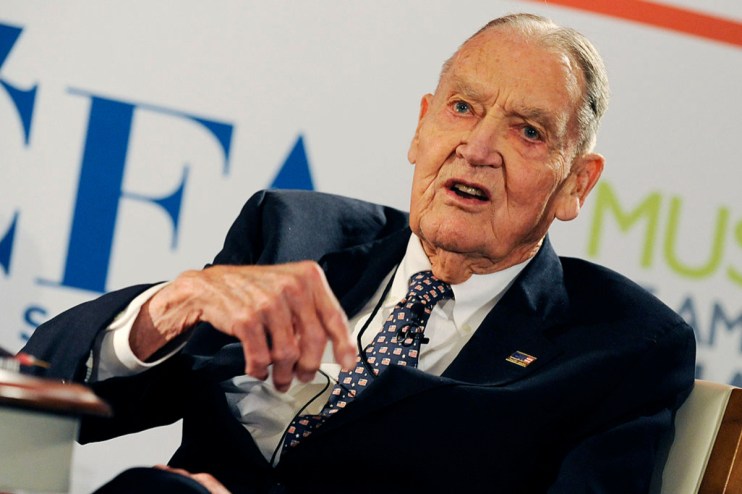
Vanguard launched its first ever tracker fund 50 years ago this month. Since then, they have had an enormous impact on the way our capital markets function – and now make up more than half all fund-held assets. Ali Lyon asks: will they be as popular when they turn 100?
The 1976 launch of the world’s first ever index fund was, in the words of its inventor, “an abject failure”.
Jack Bogle, the man behind a little-known financial start-up by the name Vanguard Group, had hoped that his newfangled piece of financial alchemy would raise anything between $50m and $150m (£28m and £83m back then). After all, its promise was alluring: match the performance of the entire S&P 500 index, and avoid the colossal fees traditional investment managers charged for determining which companies should make it into your portfolio. Why risk failing to beat the market, when you could be the market?
Instead, Mr Bogle raised just $11m. And the fund, known then as the Vanguard First Index Investment Trust, drew widespread ridicule. Commentators dismissed it variously as “un-American”, “a cop out” and a “sure fire path to mediocrity”. The Financial Analysts Journal declared it a “fad that will soon disappear”.
A short 50 years on, and Bogle has been vindicated in more ways than one. For the few investors that did choose to back his innovation – now called the Vanguard 500 Index Fund – from inception, things could hardly have panned out better. Had they invested $10,000 in 1976 – and resisted the temptation to take any profit until now – they would be sitting on a pile of US equities worth a combined $2.5m. Vanguard itself now manages approximately $12 trillion – making it the second-largest asset manager in the world. And Bogle, for his part, died as one of the most celebrated and recognised men in modern financial history.
For something written off as ‘un-American’, Vanguard’s trackers – along with its innumerable imitators and modifiers – have also proven incredibly popular in the land of the free; and not just among the retail investors at whom the innovation was targeted.
Warren Buffett – the sage-like guru behind the $1 trillion Berkshire Hathaway – has long been one of the invention’s loudest cheerleaders. Nobel Prize-winning economist Paul Samuelson, meanwhile, ranked it alongside Gutenberg’s printing press in terms of the impact it has had on 21st-century life.
The world’s retail investors have voted with their feet, too. Index-linked funds now represent more than half of all the long-term investment assets held in US funds. Even in Blighty – the spiritual home of the stock-picking investment manager – the figure has, by the Investment Association’s reckoning, climbed to over a third.
“Index funds succeeded because they solved a problem that many investors didn’t realise they had,” says James Norton, Vanguard’s head of retirement and investments. “Decades of evidence shows that consistently picking tomorrow’s winning stocks is incredibly difficult, even for professional investors. Index funds offered a simple alternative: own the market at a very low cost and keep more of your returns.”
Tracker fund fancies
The repercussions of this great financial reordering have been enormous. On the margin they have left active asset managers under pressure to differentiate their portfolios from freely available – and more cost-effective – ‘passive’ equivalents. Stock pickers have rushed to borrow more and juice returns or concentrate a greater share of clients’ cash into just a few, high-conviction bets. In some cases – as best evidenced by the SpaceX- and Anthropic-backing Baillie Gifford – they have also expanded into private assets.
The success of those efforts has varied enormously – but overwhelmingly they have failed to outperform their humble, fee-free, index-linked tracker funds.
If their impact on asset management has been profound, the knock-on effect on the behaviour of markets has been nothing short of a paradigm shift. In an age where trackers comprise more than half long-term assets markets have become increasingly momentum driven and more ‘top heavy’, says MGTS Downing Fox Funds manager Simon Evan-Cook. Trackers do not – by and large – allocate the same amount of cash to each constituent of the index they track. Rather, because the funds in question tend to be ‘weighted’ based on each company’s size, a FTSE 100 index fund will own substantially more shares in HSBC and Astrazeneca than they do Burberry or Whitbread.
Accordingly, when a company’s shares do well, passive funds are obliged to buy more of them, and a self-fulfilling feedback loop – irrespective of the initial move’s merits – is formed. The opposite is, of course, also true. Take a smaller company not blessed with index-inclusion, like the London-listed packaging-making workhorse Macfarlane Group. It could, as Macfarlane has, string together a solid track record of compounding earnings growth. And for all its efforts it could simultanesouly, as Macfarlane also has, see its shares fall nearly 50 per cent in five years. The reason? Evermore investor cash ebbing away from the kind of professional managers paid to spot an underpriced company performing well, and into index-tracking passive vehicles that exist to buy indiscriminately.

A cocktail of concentration and volatility
“These things are becoming more and more concentrated,” Evan-Cook tells City AM. “Everything is continuing to accelerate in the way that it has been: trackers perform well, so more money goes into tracking, more money goes into those large index-dominating companies, and that then just continues to accelerate.”
Weary from their years-long spell of underperformance, even Britain’s most revered stock pickers are losing faith in the methods on which their reputations were forged. Terry Smith, the feted manager behind the £13bn Fundsmith, wrote last month that trackers were contributing to a “market dominated by momentum rather than any fundamental factors like profitability, returns on capital, and growth – in other words the factors we focus on”.
The fund – which was built on the mantra ‘buy good companies, don’t overpay, do nothing’ – needed to adapt or risk extinction, he added. “Sticking to our current approach may well fall foul of the adage that the market can remain illogical longer than we can remain in business,” Smith warned in his closely followed semi-annual letter to investors. “You should therefore expect that we will be more active in future.”
In practice, he went on to say, that meant taking a greater account of the direction in which a stock was already trending, while also avoiding the temptation to snap up quality companies that “hit a glitch”. In essence, the fund manager best known for his remorseless ‘bottom up’ investment philosophy – one that picked companies solely on the basis of their fundamentals rather than macroeconomic or technical noise – had conceded defeat.
But just as Smith is bending to this era of tracker fund dominance, others are warning a reversal is overdue. For as long as valuations of the world’s largest companies appreciate – a trend to which tracker funds are contributing thanks to their feedback loop dynamic – they will continue to outperform most active investors.
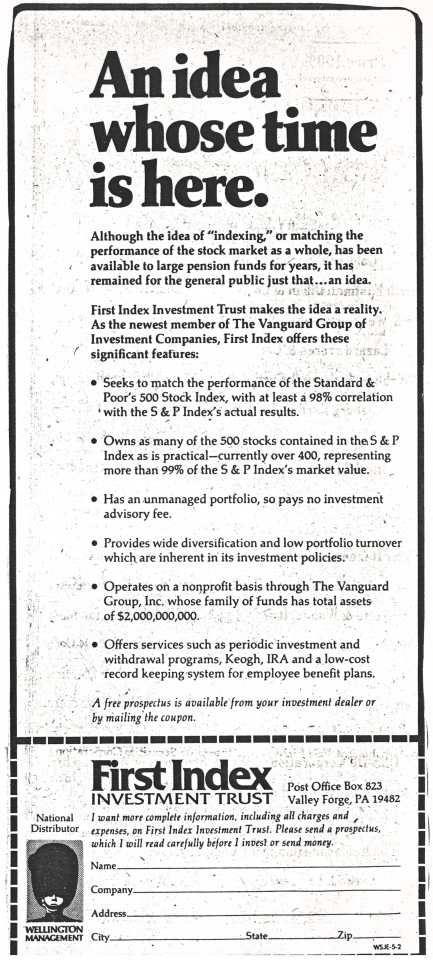
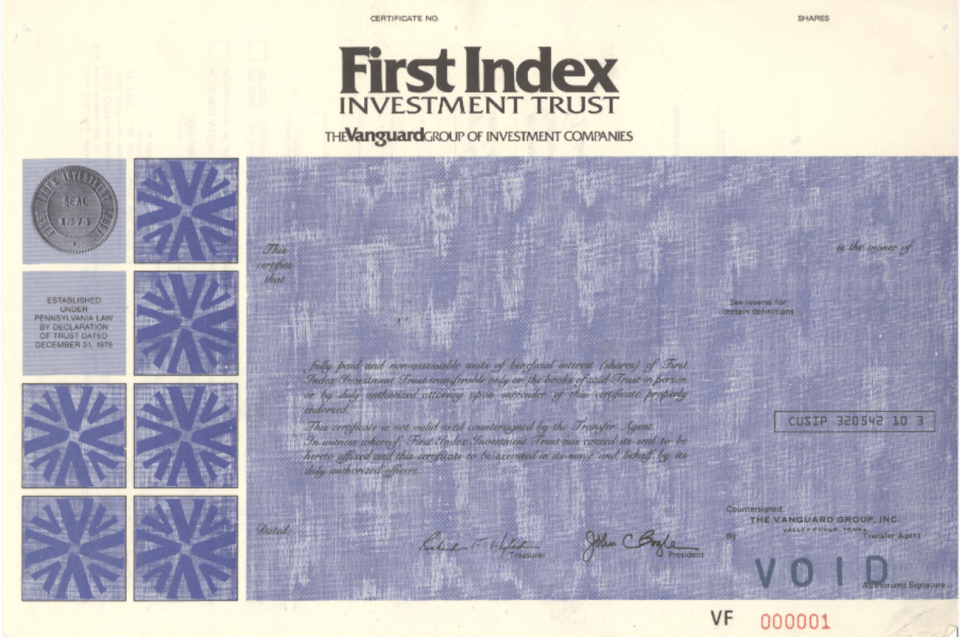
A four-year tech-driven bull market means just 10 mega-cap tech companies now make up more than half of the Vanguard 500 Index Fund. Not exactly the “wide diversification” promised in the First Index Investment Trust’s original literature (pictured). That means a fund whose original raison d’etre was to split the middle of a market’s active managers is now outperforming those investors substantially. And despite its conspicuous lack of shiny hyperscalers, in Britain the story has been the same: Vanguard’s All UK Share tracker has grown by 65 per cent in five years while the average UK equity fund has risen by less than a third.
That concentration works to investors’ benefit on the way up, says Hargreaves Lansdown head of fund research Kate Marshall. But they “shouldn’t assume this dynamic will last forever”, she tells City AM. “Market leadership tends to broaden and narrow in cycles.”
50 not out – can they make 100?
When the wind does change, tracker-based retail investors can expect a hard fall, warns Evan-Cook. If the average UK tracker fund can beat active managers by 29 per cent when animal spirits are alive and hackles are up, what’s to stop them doing the same in reverse when risk sentiment dims? Active investors can sell – or simply never have owned – frothy companies like Coreweave and SpaceX in the US, or Samsung and SK Hynix in Korea. Tracker funds? Not so much.
There is also a chance that markets themselves might cease to function in a way that resembles normality. As Evan-Cook outlined in a recent blog, Vanguard’s original index vehicles were designed to hitch a ride on the combined brains of hundreds of thousands of investors – like a small man, getting on a large train. But what happens when the thing that was meant to be hitching a ride on something larger turns into the dominant force? To stretch the railway metaphor further, the man gets bigger, and the train gets smaller, until a derailment becomes inevitable. In the real world, argue Fudsmith’s Smith and Evan-Cook, that means evermore volatility and whipsawing markets until the entire pricing mechanism shatters.
“Complete victory for passive would be good for no one, including passive investors,” Evan-Cook wrote. “Passive investing is designed to work alongside active, so if there is no more active, passive wouldn’t work either.”
For now, though, there is little to suggest retail investors won’t continue to gorge on the one innovation that has done more to give households exposure to capital markets than any other. In the past 10 years alone, passive strategies have sucked in an additional $6.1 trillion. Active funds, meanwhile, have bled more than $3 trillion to their cheaper counterparts.
But after a world-altering first 50 years, will they still be a major investment force on their 100th anniversary?
“Definitely – for as long as humanity exists, trackers will,” Evan-Cook tells City AM. “At this rate, I’m more confident on the tracker making it to another 50 years than I am on humanity.”