Reform’s London mayor pick: I want to design London like an iPhone

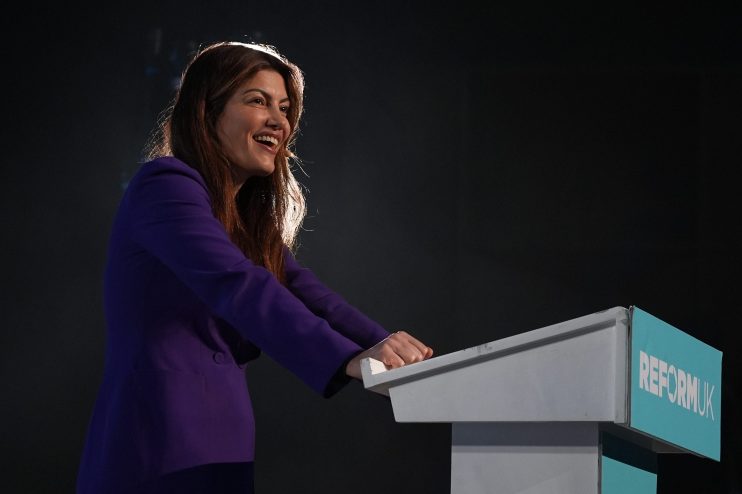
Londoners are steadily finding out who will be on the ballot sheet for the next mayoral election in 2028. Mauricio Alencar spoke to Reform UK’s candidate Laila Cunningham about her tunnel-vision approach to getting things done.
Laila Cunningham has a simple pitch to Londoners. While, for the moment, it looks like Labour and the Tories could stand candidates with knighthoods, Reform UK’s London mayoral pick argues she did not experience the capital “through a ministerial car for the past 10 years”.
“It’s two Sirs and a Londoner – Sir James [Cleverly] and Sir Sadiq [Khan],” she told City AM in an interview.
“I don’t think the answer to London is two Sirs battling it out. One who wrecked the country and the other one [who] wrecked the city. I don’t think that’s what Londoners want.”
Cunningham was announced as Reform UK’s candidate in the first week of January this year, two years before the mayoral election. It may be just as well. Khan, who has not yet confirmed whether he will stand again in 2028, has been the mayor for 10 years while Cleverly, who still needs to win the support of members before launching his formal campaign, was close to becoming the Tory party leader after the last General Election. Londoners are more likely to recognise either figure on a ballot sheet while Cunningham still has some way to go before winning them over.
The former Crown Prosecution Service lawyer, who defected from the Tories to join Nigel Farage’s party in mid-2025, has looked to build her reputation by focusing her message on crime in London.
In an interview with City AM, Cunningham opened up about her economic ambitions for the capital. Making London affordable has become just as critical to her long-term mayoral campaign as making it safer. Some policy announcements, such as on expensive transport fares, are set to come imminently, she revealed to City AM.
Like her electoral pitch, her overall business policy pitch to Londoners is direct: “When I see London, I want to design it as if I’m designing the new iPhone.”
She said she wanted to make life in the city “easier”, more “intuitive”, and less costly. Brainstorming the technologies that could change Londoners’ interaction with state-based services, she floated the idea of a new TfL app telling commuters about disruptions and quicker payment methods for congestion charges and parking tickets.
But, for the moment, her platform is one built mostly on problems rather than solutions.
Laila Cunningham’s complaints
During a half-hour conversation, she railed against Ulez and blamed Cleverly for stealing her slogan pledging to end the “war on motorists”. “Every time I release a policy, James Cleverly literally uses words from my speech,” she complained.
She also hit out at affordability targets, which require developers to ensure a certain amount of flats are in reach of lower income Londoners, and said they are hampering property developers. She criticised a lack of coordination between councils on the introduction of cycle lanes, and slammed council in-fighting that has left Hammersmith Bridge closed to motorists since 2018.
When asked whether she would like the mayor to take power over the bridge’s repair, she questioned why Khan had not already done so. But Cunningham’s responses to questions on how she would solve the issues she rails against may trigger concern from potential voters hoping to hear a clear plan.
“Give me the money, and I’ll fix it,” she said when asked about how to solve the bridge impasse.
Where would the money come from? Would she consider tariffs, new taxes or some private financing scheme to provide the substantial £300m funding to get repairs done? “Whatever it takes,” she responded, adding it would “have to be [funded by] the government”.
“I’m sure there’s a lot of money floating around, by the way, when you really cut down to it. I think a lot of the green initiatives, for instance. [Khan] announced £17m on workshops to combat hate crime. I don’t want that. I want more money to improve roads and to fight crime. I don’t need bloody workshops.
“I just feel like there’s no can-do [attitude]. It’s like, ‘let’s have a committee, a review’. I think perhaps that’s the problem with the government – it’s too bureaucratic.”
The mayoral candidate offered similar answers when asked about her plan to make tubes driverless. Does she expect strikes to follow? “Naturally” but “just because it’s difficult, you can’t say you’re not going to do it”. How quickly would it happen? “I’m hoping that should I lose the next administration, we’ll keep it going because I can have proof of concept”.
How would the dramatic change in transport technology be paid for? “I don’t pretend to be an expert on automation – you can get private industry to fund it”.
Reform UK’s chances in London
Two years out from an election, Cunningham has plenty of time to think proposals through more fully. But on everything from transport to the economy, she has taken the opposite line to the mayor. While Khan has warned that AI could become a “weapon of mass destruction of jobs”, Cunningham has said she wants to “utilise AI to the max”. She defends Palantir’s roll-out across the Metropolitan Police just as the mayor’s office is facing a lawsuit by the tech giant over a decision to block a key contract.
Cunningham insists public services in the city will not improve “by hiring more people” – “you’re going to get that by leveraging technology to reduce the cost of production and the cost of output, and the only way to do that is to use AI”.
She may also benefit from the fact that the next election will switch back from first past the post to a supplementary system. Right-leaning voters who were thinking about voting tactically against Labour may be more inclined to put Reform UK first. The party performed better in London Assembly elections, which used a proportional additional member system, than in the last mayor elections, which used first past the post.
Cunningham believes that London is not split between left and right, and people’s concerns are more “issue-based”. This belief may guide a difficult campaign in an area where Reform only managed to take control of one out of 32 councils in May despite racking up more than a hundred across England. For some of the electoral difficulties that the Tories have faced in the last four years, the party has control of six councils in the capital, providing it with more confidence that it could take on any Labour pick.
She is not concerned about scrutiny surrounding the wider party’s funding. Her focus and priority is “London, London, London” – even if it means, she says, picking a fight with a potential Prime Minister Farage over funding provided to the capital. Cunningham also believes that she could defend the capital’s interests just as plans for devolution and more funding for some of Britain’s more impoverished areas gather momentum
The mayoral candidate’s opponents argue that her political messaging is too negative about the capital. She claims she is in a better place to provide a “unifying message for London”.
But in her battle to win over a city long-seen as a Labour stronghold, she may soon be forced to move beyond fierce criticism of Khan’s mayoralty to provide solutions to fixing London’s problems herself.