Rolls-Royce Spectre Series II review: Driving a Rolls on a racetrack – yes, really…

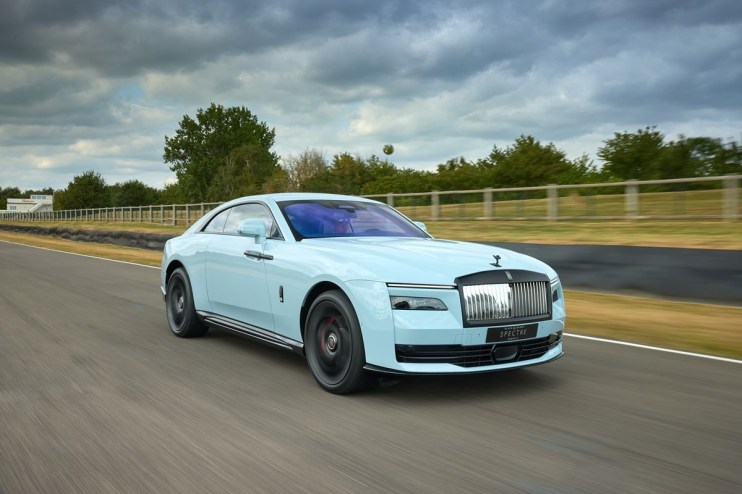
Hang on, you are cordially inviting me to do what? I re-read the email to make sure, but it’s there in crisp Sans Serif font. It isn’t every day you get asked to drive a Rolls-Royce on a racetrack. Indeed, in 20 years as a motoring journalist, this is the first – and likely the last – time it has happened. So I graciously accept, obvs.
Several weeks later, I arrive at the historic Goodwood Motor Circuit – situated a stone’s throw from the Rolls-Royce factory in West Sussex – for a rendez-vous with the Spectre Series II.
I attend a driver briefing, sign my life away and find a suitably sized crash helmet. Then it’s out to the pit lane, where the Rolls-Royces are lined up like whales out of water. The amusing prospect of hustling this 2.9-tonne behemoth around one of Britain’s fastest, least forgiving circuits suddenly seems a lot scarier. Was this a silly idea after all?
The most powerful Rolls-Royce ever
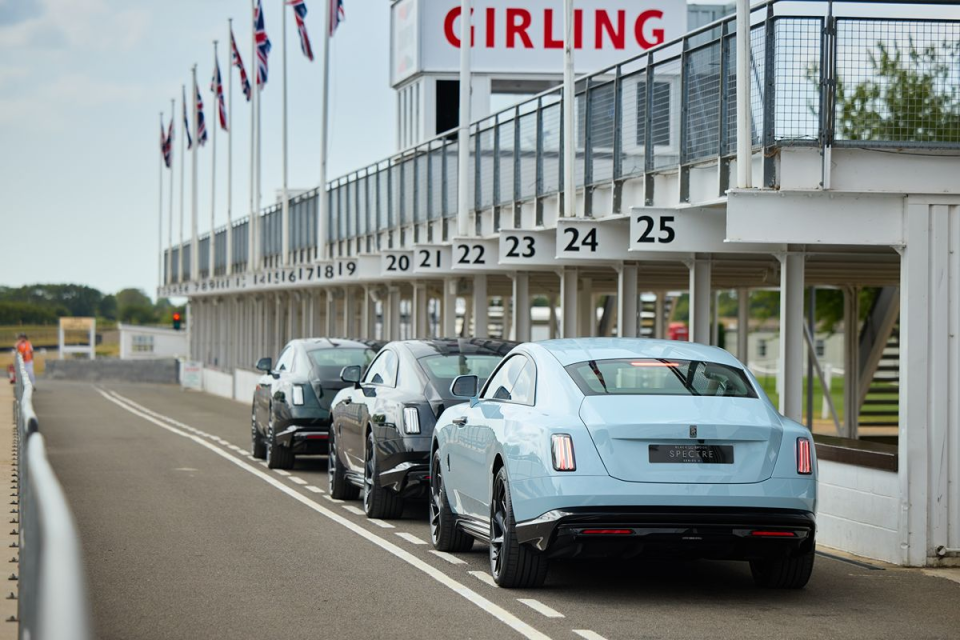
In contrast to the Ferrari Luce, which sent social media into paroxysms of fury, Rolls-Royce’s first attempt at an EV has been generally well received. In fact, the Spectre is now the marque’s best-selling car in Europe, even if the Cullinan SUV finds more customers worldwide.
There are two main reasons, I think, for the Spectre’s success. Firstly, it looks like a Rolls-Royce: elegant and aristocratic, with a hewn-from-solid quality that is imposing rather than overtly ostentatious. Secondly, it drives like one: effortless, cosseting and incredibly quiet. As CEO Chris Brownridge rightly observes: “a Rolls-Royce is perfectly suited to electrification”.
Given the Spectre mostly got things right from the start, changes for this mid-life update are modest. Visually, a new design of 23-inch forged wheel is the only way to tell the Series II model apart. However, under the skin you’ll find a larger 112.4kWh battery (up from 102kWh previously) to increase the official range from 329 to 390 miles. A peak charging speed of 195kW also means a 10-80 percent fill-up now takes 28 minutes – six minutes swifter than before.
There’s a boost in power and torque, too: up from 584hp and 662lb ft to 600hp and a mighty 749lb ft. Opt for the Spectre Black Badge and selecting Infinity mode unlocks 680hp and 811lb ft. It’s the most powerful production Rolls-Royce ever.
Inside the Spectre Series II
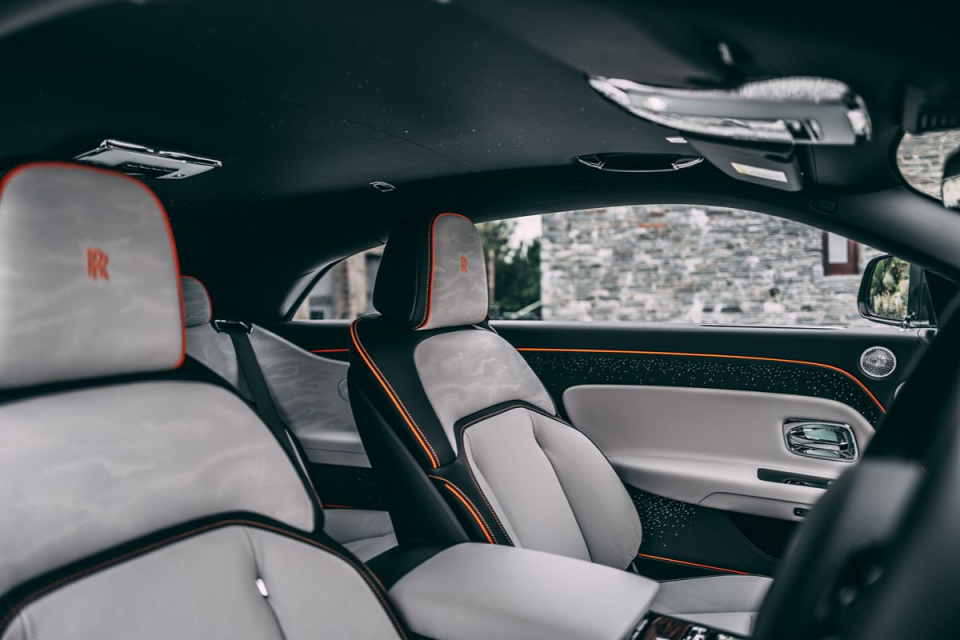
Open its enormous, motorised and rear-hinged doors and the Spectre invites you inside. It majors on plush, tactile materials and bespoke detailing, rather than wall-to-wall screens and cutting-edge tech – and is all the better for that. Like Bentley, Rolls-Royce has recognised the value of a ‘digital detox’ to promote a sense of wellbeing.
Most coupes are low-slung, but in the Spectre you sit up almost at SUV altitude, looking out over a long bonnet with the Spirit of Ecstasy statuette somewhere in the middle distance. There’s plentiful space for four adults in here, too – not something you can say about a Bentley Continental GT.
There are various new trim materials for the Series II, including a bamboo-based, monogrammed fabric called Duality Twill that requires 2.6 million stitches and 10 miles of thread to finish a full interior. There’s also a new Brindled Walnut veneer, made with eucalyptus fibres left over from paper production.
In truth, though, with a big enough budget, the opportunities to personalise your Rolls-Royce are almost limitless.
Rolls-Royce tested on-track
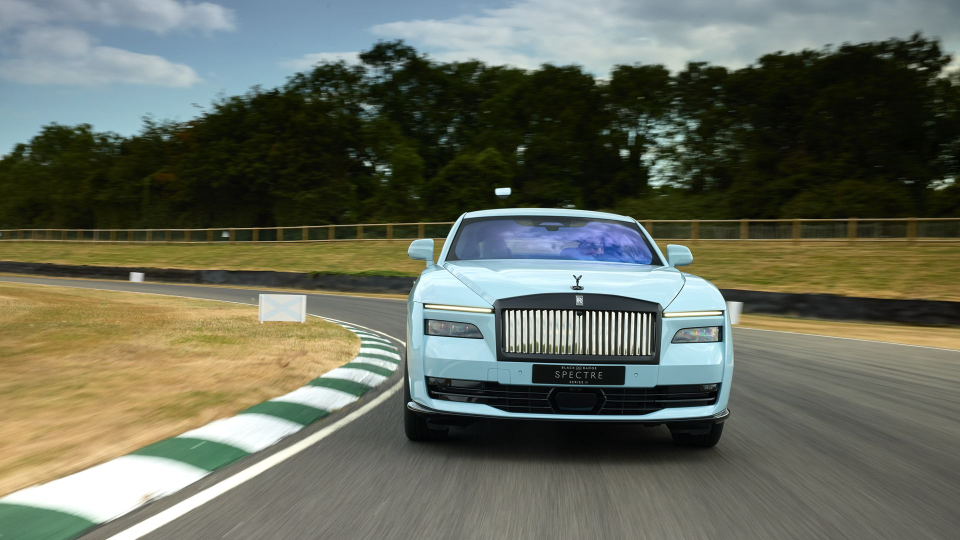
The reason for testing the Spectre on-track was, in fact, less a PR stunt and more a legal necessity. These Series II models were near-production prototypes – and thus not registered for the road. In every aspect apart from the DVLA paperwork, however, the experience would be identical.
Except nobody experiences a Rolls-Royce quite like this. We start with a slalom course on the pit straight. At low speeds, the Spectre’s anti-roll bars automatically disconnect to soften the ride, but above 10mph they tighten up, increasing the resistance to roll. There’s still more lean than a sports car, but the way this supersized coupe – longer and heavier than a Range Rover LWB – carves between the cones is truly impressive.
The Spectre’s agility is also enhanced by rear-wheel steering, which tightens its turning circle when manoeuvring and tucks it into tight corners. It’s accurate and intuitive, helping you place the car with confidence. A thicker-rimmed steering wheel than the Rolls-Royce norm provides a sportier feel, too.
Fast laps with a champagne stop
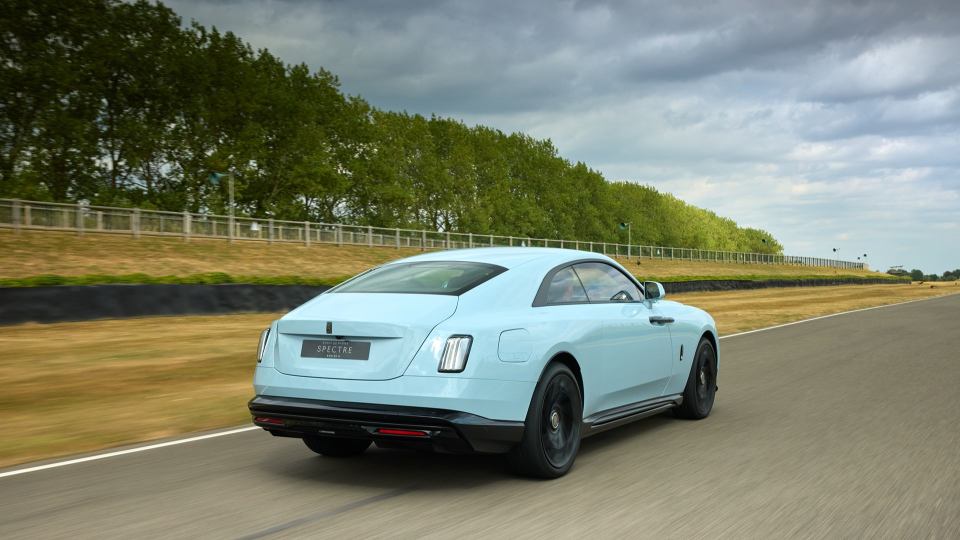
Then it’s time for some laps of the Goodwood circuit. My first session is to be driven at ‘country road speeds’ – i.e. not exceeding 60mph – to get a sense of how the Spectre Series II would perform in the real world (such as it exists for Rolls–Royce owners, who typically own six other cars).
Apart from being almost inaudibly quiet, what first strikes you about the Spectre is how smoothly it makes progress. There’s no uncouth wallop of acceleration, as in some powerful EVs (0-62mph takes 4.5 seconds). All the controls, from the long-travel throttle to the fingertip-light steering, feel calmly and precisely calibrated. There’s ample grip and the car gamely holds its line through the lengthy Madgewick and Lavant corners.
The brakes fell equally unruffled. In normal circumstances, the Spectre rolls to a ‘champagne stop’ – so-called because it’s seamless enough for partying passengers not to spill their drinks. My emergency stop on the Lavant straight is scarcely more dramatic. The ABS must be working overtime, but there is absolutely no vibration through the pedal or deviation in the steering. It stops from 60mph in just 15 metres, or about three car-lengths.
A blast in the Black Badge
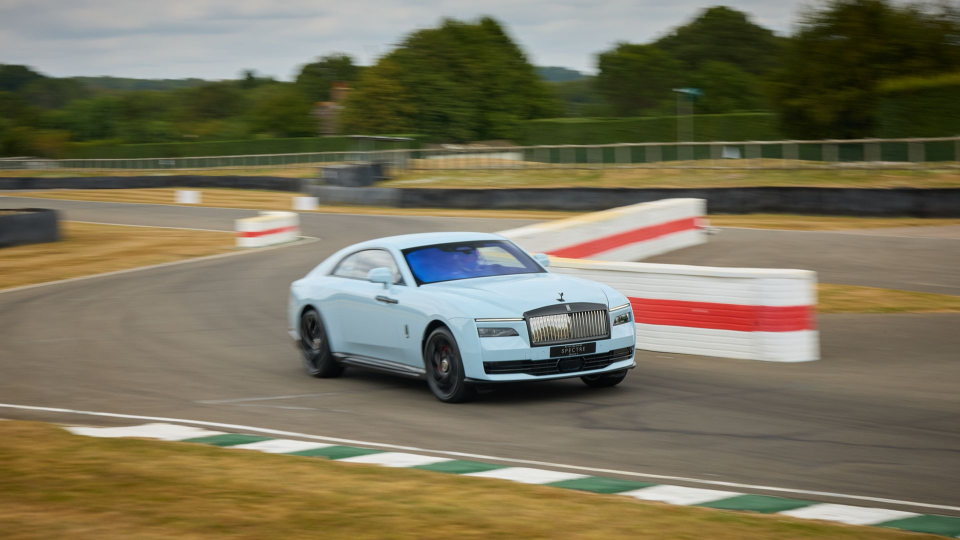
Finally, I swap into a Black Badge for some hot laps with no speed limit. Use the ‘Spirited’ launch control and this Spectre dashes to 62mph in 4.3 seconds (0.2sec quicker than its ‘standard’ sibling), plus there is even more mid-range muscle to call upon – not to mention the bragging rights that come with owning the quickest Rolls-Royce of all.
The lack of run-off at Goodwood could become a concern when piloting a near-three-tonne EV, but neither I nor the Black Badge ever breaks a sweat. Granted, this isn’t a car that encourages you to grab it by the scruff and throw some shapes, but nor does it wobble about unwillingly like Rolls-Royces of old.
You can even make use of the regenerative braking, carrying speed through corners and simply flexing your right ankle to match the ebb and flow of the circuit. It’s a cerebral and very satisfying way to make progress.
Verdict: Rolls-Royce Spectre
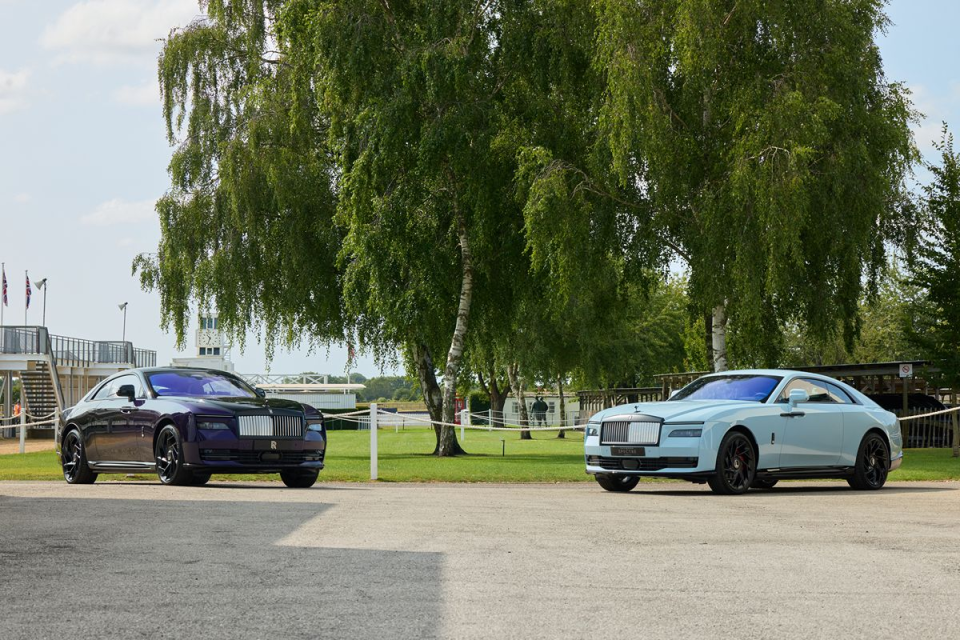
I finish the day with a drive in a well-used Spectre Series I. It’s a factory development vehicle that Rolls-Royce technicians call the ‘mileage car’, having amassed 74,000 miles since 2024. Given the average Spectre covers 4,000 miles per year, that’s more than 18 years of typical driving.
Frankly, it’s hard to tell the difference. The battery health display still shows 98 percent and the cabin feels as hermetically sealed and solid as ever. If I didn’t know otherwise, I’d believe this car was factory-fresh and just purchased for £333,185.
If the price sounds steep, bear in mind that a Ferrari Luce will set you back a whole lot more (circa. £450,000). And while the Italian stallion will surely post quicker lap times, the British bruiser won’t feel out of its depth on a racetrack. Not that you’re ever likely to drive it on one.
• Tim Pitt writes for Motoring Research