On this day: the birth of press freedom

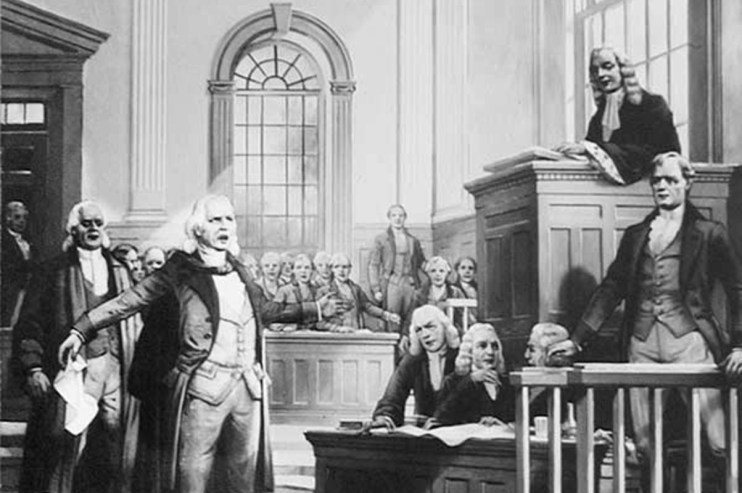
On 5th August 1735 John Peter Zenger was acquitted of seditious libel on the basis that the criticisms of the government he has printed in The New York Weekly Journal were true. It was a judgement that established the basis of press freedom on which western democracy still depends, writes Eliot Wilson
By the end of the 17th century, freedom of the press was not a central feature of most societies. In England, the Licensing of the Press Act 1662 existed ”for preventing the frequent Abuses in printing seditious treasonable and unlicensed Bookes and Pamphlets and for regulating of Printing and Printing Presses”. The Bill of Rights 1688 referred to freedom of speech in the context of parliamentary privilege, but was silent on the press. The glue which held society together was conformity, not individual freedom.
In 1694, however, the Licensing of the Press Act expired. Although ultimate responsibility for what was said in print remained, printers no longer operated under such a closely controlled régime. The door had been forced open just an inch. And the prevailing weather in England affected the climate of its 13 North American colonies.
John Peter Zenger was a Rhinelander, born in 1697, who had crossed the Atlantic in the great Palatinate Migration of 1710. The governor of New York had pledged to find apprenticeships for all the children of Palatine refugees, and young Zenger was bound for eight years to William Bradford, the first printer in New York.
Zenger was working as a printer in New York by 1722, and three years later he became Bradford’s partner when the latter launched The New York Gazette, the city’s first newspaper. It was not very good: only two pages, poorly printed, carrying foreign news which was months out of date, state papers, lists of ships entered and cleared and a handful of advertisements. It was also studiously loyal to the colonial government.
In 1732, an Irishman, Brigadier General William Cosby, was appointed “Captain General & Governor in Chief of the Provinces of New York, New Jersey and Territories depending thereon in America”. He had a reputation for high-handedness and hard-nosed self-interest, and quickly came into conflict with leading New Yorker critics of heavy-handed colonial administration like Rip van Dam, a merchant in his early 70s and president of the Governor’s Council, and chief justice of the New York Supreme Court Lewis Morris. The latter was swiftly removed from office for his dissenting, anti-Cosby opinion in a case between the governor and Van Dam.
William Bradford’s New York Gazette would print not a breath of opposition to Cosby. The Popular Party decided it must have its own publication, and the only other printer in New York City was John Peter Zenger. On 5 November 1733 – was the date significant? – he printed the first issue of The New York Weekly Journal with finances coming from van Dam, Morris and others. It published anonymous articles by Morris, former New Jersey Attorney General James Alexander, young lawyer William Smith and others which tore into the governor’s administration and conduct.
On 15 January 1734, Cosby ordered copies of the Journal burned on Wall Street. Two grand juries declined to issue an indictment against Zenger; so in November, the governor issued a proclamation condemning “divers Scandalous, Virulent, False and Seditious Reflections, not only upon the whole Legislature, in general… but also upon His Majesty’s lawful and rightful government, and just Prerogative”. The new Chief Justice, 30-year-old James De Lancey, issued a bench warrant 11 days later and Zenger was arrested for seditious libel.
Notes from the prison
Zenger spent eight months in jail – still writing for the Journal, his articles headed “From my Prison” – before his case came to trial, on 5 August 1735. He was represented by former Pennsylvania attorney general Andrew Hamilton, one of the best advocates in the colonies, who began by saying that Zenger admitted printing the offending publications. But he argued that the criticisms in the paper were “the right of every free-born subject to make when the matters so published can be supported with truth”.
Prosecuting, Richard Bradley, attorney general of New York, dismissed this contention: “The jury must find a verdict for the King; for supposing they were true, the law says that they are not the less libelous for that.”
Hamilton appealed directly to the jury. “What my client is charged with is not a libel,” he maintained. “The falsehood makes the scandal, and both make the libel.” This was not about the narrow interpretation of law.
“It is not the cause of a poor printer, nor of New York alone, which you are now trying: No! It may in its consequence affect every freeman that lives under a British government on the main of America. It is the best cause. It is the cause of liberty.”
Chief justice De Lancey advised the jury that it was a straightforward case: Zenger had printed the Journal. That was libel. The jurors withdrew but returned within 10 minutes, and the foreman, Thomas Hunt, announced their verdict: not guilty. There was cheering in the courtroom and Zenger was released the following day.
The acquittal of John Peter Zenger did not change the law. It had been a case of jury nullification: the jurors knew Zenger had committed the crime of which he was accused, but still acquitted him. They had been persuaded by Hamilton’s argument that unless truth was a defence against libel, it was impossible to criticise those in authority.
The Zenger trial changed the way people thought about this kind of criticism. English common law not only afforded no weight to truth, but operated on the maxim that the greater the truth, the greater the libel. Then Zenger was acquitted. Gouverneur Morris, one of the Founding Fathers – and son of Lewis Morris who had helped establish The New York Weekly Gazette – called the verdict “the germ of American freedom, the morning star of that liberty which subsequently revolutionized America”.
The United States Bill of Rights was ratified 56 years later, the blink of an eye for history. The First Amendment is clear: “Congress shall make no law… abridging the freedom of speech, or of the press”. It is hard to imagine that sentiment expressed by any government before Zenger’s trial. Not long afterwards, the Sedition Act of 1798, while criminalising seditious libel, placed the idea of the defence of truth on America’s statute book.
In Britain in the 1760s, seditious libel was the charge the government used to pursue radical MP and journalist John Wilkes, with limited success. Opinion was turning against the offence, increasingly persuaded that it was an instrument of oppression.
The Libel Act 1792 allowed juries rather than judges alone to determine what was a libel. The defence of truth, provided “it was for the Public Benefit that the said Matters… should be published”, was established by s.6 of the Libel Act 1843. The common law offence of seditious libel was finally abolished under s.73 of the Coroners and Justice Act 2009.
We take it for granted now that we cannot be held criminals for, in Bayard Rustin’s phrase, speaking truth to power. The government cannot seek – though many will still try – to suppress facts because they are inconvenient, and it is a foundation of a free society that our rulers must be held to account. That was not the case when John Peter Zenger appeared before the Supreme Court of New York on Friday 5 August 1735. When the jury came back after 10 minutes’ deliberation that day, the freedom of the press had taken a great stride forward.
Eliot Wilson is a writer and historian