Why Guildhall Art Gallery and Roman Amphitheatre deserves a Toast Award

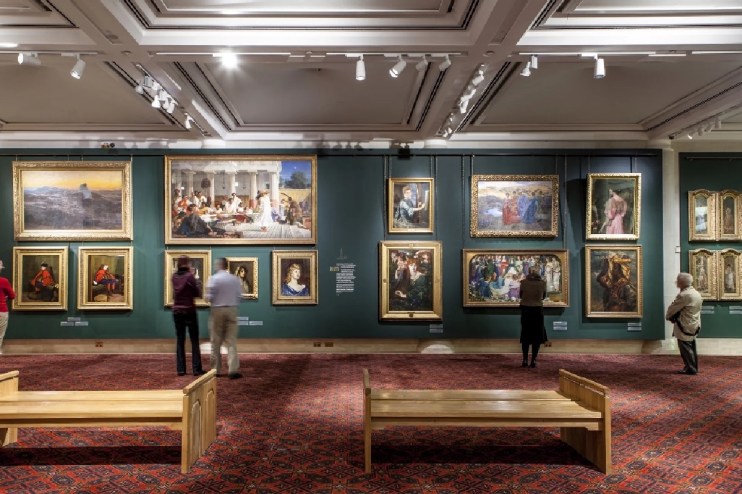
What major London gallery contains the second largest oil painting in the country, pre-Raphaelite masterpieces, mystery paintings, biting political art and an ancient Roman building in the basement?
This is The Guildhall Art Gallery, the City’s hidden gem, designed to be “a Collection of Art Treasures worthy of the capital city” when it was built in the 1880s, as a rival to municipal galleries around the country and Westminster’s host of cultural attractions.

The original gallery was destroyed in the “hardest night” of the Blitz on 10 May 1941, when over 700 tons of bombs were dropped over London, leaving 1,400 dead and 700 acres of total devastation.
Luckily much of the collection had been removed, although several hundred works were lost, and it took until the 1980s before the City finally agreed the plan to rebuild it. The construction work halted for several years after the discovery in 1988 of something totally unexpected, a Roman amphitheatre beneath the complex, dating back to the first century.
The Guildhall Roman amphitheatre
This amphitheatre would have held more than 7,000 people – over ten per cent of Londinium’s Roman population – and the section underneath the gallery has been preserved by building a 700 tonne steel raft to lift the gallery over the Roman remains.
It is now part of the gallery experience: you can finish your visit by exploring the games area, arriving through one of the original entrances with what we suspect to be an animal cage area to your right.
The collection is terrific – on the top floors you will find mostly Victorian art, including the Dante Gabriel Rossetti masterpiece La Ghirlandata. The Pre-Raphaelites coined the phrase “stunner” for their models, and this one is no exception: the image of Alexa Wilding is a typical pose, a red headed beauty gazing at you, loose clothed, touching a harp surrounded by lush greenery.
Rossetti treated women terribly – he buried his wife, the talented artist Elizabeth Siddal (a great artist in her own right who had modelled for the famous portrait of Ophelia), with the sole copy of his poetry manuscript. Seven years later he had her body dug up so he could publish the poems.
The second largest oil painting in the country straddles two floors at the rear of the upper floor, called The Defeat of the Floating Batteries of Gibraltar 1782. It is a record of one of Britain’s great defences, the three year siege of Gibraltar in which the Spanish secret weapon, the floating batteries, were defeated by British ingenuity.
The Lord Mayor’s Show
On the ground floor is a wonderful painting of the Lord Mayor’s show of 1888, with a follow-up painting of the 2010 show opposite – it is raining heavily on both days as tends to happen for the Lord Mayor’s show.
Next to these is a section I call Radicals Corner, full of artists including Fiona Banner and Grayson Perry, full of sharp criticism of the City, capitalism and imperialism.
Below these we pass the Heritage Gallery with its archive material and then we arrive at the earliest paintings in the collection, dealing with the Great Fire and reconstruction, all the way through to modern London life.
- The Guildhall Art Gallery is free to the public and open 10-5 every day, with free guided tours from City guides every day except Monday at 12:15 and 13:15. Visit the website here.