Trump’s tariff decisions send shockwaves through the markets

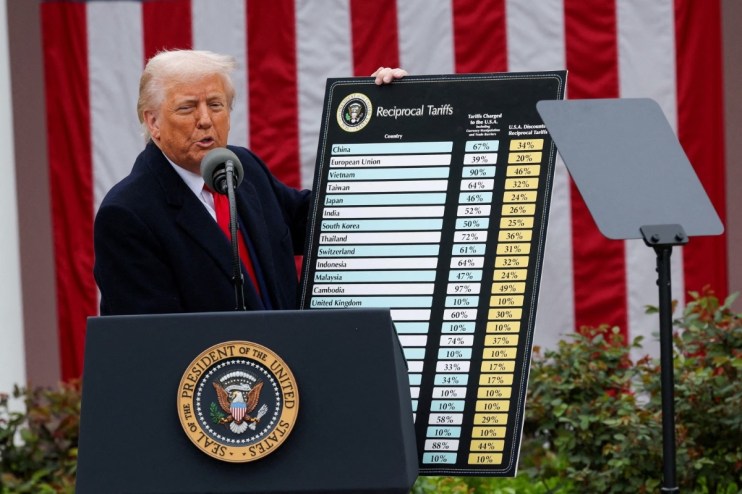
Global assets and markets have once more found themselves reeling from the aftershocks of Trump’s tariffs decision, after his weekend announcement sent investors scrambling.
The US president announced a 15 per cent blanket tariff on Saturday in rebuttal to the Supreme Court striking down his signature economic policy.
Bitcoin suffered a sharp selloff on Monday morning, falling 4.7 per cent to $65,725.91 (£48,607.27).
Ether fell roughly four per cent to $1,878.80, with the digital asset’s value dropping 34 per cent this year to date.
Saxo analysts noted the move was “macro-driven”, reflecting investor’s softening sentiment towards riskier, speculative assets rather than a specific problem with the digital currency.
Meanwhile, gold continued its rally after the tariff turmoil sent both new and seasoned investors back to the safe haven asset.
Gold climbed 0.45 per cent to $5,132.61 per ounce, surging to its highest level in three weeks earlier in the morning, trading at $5,161.64. Silver was also buoyed, rising 0.33 per cent to $85.97.
While Trump’s decision lifted bullion, it weighed the dollar down. The pound was higher against the dollar, up 0.4 per cent to $1.353, while it also sank against the euro by 0.3 per cent at $1.18.
The greenback also suffered in Asia, falling 0.3 per cent against the yen.
Asian markets brush off uncertainty
Asian markets rose this morning, with both South Korea and Taiwan setting records in early trading, shrugging off the uncertainty.
Investors flocked to the region to secure tech, automotive and industrial stocks away from the concentrated US market. The Kospi rose two per cent in early trading, before levelling at 0.65 per cent, trading at 5,846.09 KRW.
The index was bolstered by tech giant Samsung, which rocketed 5.4 per cent to 3,402.80 KRW, while HD Hyundai Electric jumped 5.5 per cent to 1,067 KRW.
Taiwan’s Taiex also initially crossed the 34,000 mark for the first time, before settling at a 0.5 per cent rise, trading at NT$ 33,733.26.
Elswhere, returning from the Lunar New Year break, Hong Kong’s Hang Seng index rose 2.46 per cent to 27,062, while India’s Sensex creeped up 0.4 per cent.
Analysts are also predicting US markets to lose gains earned late last week, after the weekend’s announcement shift investors sentiment.
Richard Hunter, head of markets at Interactive Investor, said: “The initial market reaction to the ruling was positive, lifting the likes of Amazon and Home Depot who in theory could benefit from tariff refunds.
However, as the weekend events unfolded, sentiment has turned and the current indication is that the main indices will reverse any such gains when trading resumes later.”
FTSE falls flat
The FTSE 100 fell flat in early trading, as companies and investors grapple with what the new tariff regime will mean for the UK and the rest of the world.
The flagship index dropped 0.19 per cent to 10,666.97, while the FTSE 250 slumped 0.45 per cent to 23,643.72.
Matt Britzman, senior equity analyst at Hargreaves Lansdown, said: The FTSE 100 is expected to open slightly lower this morning as fresh trade uncertainty filters through from across the Atlantic.
The UK had seemingly done its homework, securing a 10 per cent trade deal with the US, but the White House’s new 15 per cent blanket tariff rather takes the shine off that achievement, dragging the UK back into fresh trade uncertainty.
“While the White House insists that all existing trade deals remain intact, the EU is already making noises about pausing negotiations until the new landscape becomes clearer.”
Optimism is the US is also fading, with US futures pointing lower “as the dust settles” and investors brace for another wave of tariff negotiations and fallouts.