On This Day: Scotland says “nae thanks” to independence

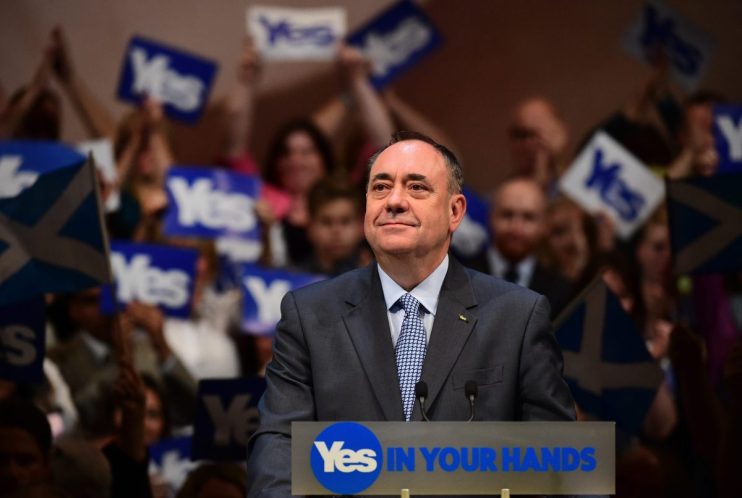
On 18th September 2014, Scotland voted against 55 per cent to 45 per cent against independence in a referendum that was supposed to settle the question for a generation, writes Eliot Wilson
It is firmly within my lifetime that the idea of Scottish independence was a harmlessly quirky cause on the fringes of politics. After a false dawn in the early 1970s, the Scottish National Party found the 18 years of Conservative government under Margaret Thatcher and John Major a cold house. It bumped around between a tenth and a fifth of the popular vote, and from 1979 to 1997 they never won more than three of Scotland’s 72 seats at one time.
When former Labour MP Jim Sillars switched to the SNP and unexpectedly trounced his old party to win the Glasgow Govan by-election in November 1988, there had been a crackle of excited optimism. Incautious souls, of whom the SNP was never in short supply, took up the slogan that Scotland would be “free by 1993”. Alex Salmond, quick, glib, canny, stormed to the party leadership in 1990.
But the hope faded again: three seats in the 1992 general election, then six in 1997. The SNP had doubled its seats with an increase in the vote of 0.6 per cent, because the Conservatives were wiped out, their remaining 165 MPs all from English seats.
But the Blair government did an extraordinary thing. Within four months of taking office, it held a referendum in Scotland to choose between the propositions “I agree there should be a Scottish Parliament” and “I do not agree there should be a Scottish Parliament”. By three to one, the electorate did agree, and within 14 months, the Scottish Secretary, Donald Dewar, had steered the Scotland Act 1998 onto the statute book. The new Scottish Parliament was elected and first met in May 1999.
There were principled devolutionists in the Labour Party. Donald Dewar went north to become First Minister of Scotland, and, in his wry, reserved way, a kind of father of the nation. He was not completely sorry to go: his wife Alison had left him in 1972 for a barrister who was now Lord Irvine of Lairg and Lord Chancellor. Dewar had never remarried nor forgiven Irvine.
But there was a tactical play. Labour expected that a devolved assembly would entrench its dominance in Scotland, and drain support from the SNP by satisfying voters’ wish for greater autonomy. George Robertson, Blair’s Shadow Scottish Secretary, predicted that devolution would “shoot the Nationalist fox”. The voting system, of 73 constituency MSPs and 56 from eight regional lists, was supposed to make coalitions inevitable, and in 1999 Labour agreed a cosy agreement with the Liberal Democrats. It seemed Lib-Labbery was the future.
Then came the election of 3 May 2007. The SNP edged into first place to win 47 seats. Labour with 46 MSPs and the Liberal Democrats with 16 were three short of a majority. The SNP could only secure the limited support of the two Green MSPs, but when the Parliament met two weeks later to choose a First Minister, Alex Salmond beat Jack McConnell 49-46 in the second round. He led a single-party SNP government, two things which were supposed to be impossible.
From then the clock was ticking. In 2011, the SNP won 69 seats, enough for a majority without coalition partners. The Labour, Conservative and Liberal Democrat leaders all announced their resignations. And Alex Salmond, 56, sensed the opportunity of a lifetime. Declaring that the SNP had won “a victory for a society and a nation”, he announced that there would be a referendum on Scottish independence in the “second half of the parliament”.
There was one obstacle. The Scotland Act 1998 had listed matters which remained “reserved” to Westminster and which were outside the competence of the Scottish Parliament. It said that the devolved assembly could not legislate on, among other issues, “the Union of the Kingdoms of Scotland and England”.
The UK government offered to pass a so-called Section 30 Order which would temporarily extend Holyrood’s powers and allow it to legislate for a referendum, but ministers warned that the poll must be “fair, legal and decisive”. Salmond, shrewder and cannier than he was honest or straightforward, saw the opportunity at first to attack “London interference” and strengthen the case for independence. But he also knew that if he won the referendum, any legal uncertainties would be to his disadvantage. In October 2012 the two sides signed the Edinburgh Agreement, setting the terms and arrangements for the vote.
Would Salmond win? At the end of 2011 it seemed impossible: a YouGov poll put support for independence at 34 per cent, those against it at 52 per cent and just 12 per cent undecided. A year later, the SNP’s cause seemed just as doomed. The SNP and its allies would have to win over every voter yet to choose as well as converting a fifth of those against independence, without losing any of its existing supporters.
The beginning of the official election period on 30 May 2014 came and went and the prospects for the Yes campaign stubbornly refused to improve. With a handful of exceptions, its support simply would not go significantly above 40 per cent, while the No campaign often scored in the high 40s and regularly rose beyond 50 per cent.
Heart v head
Inevitably, it was a heart v. head battle. The Scottish Government’s 650-page manifesto for independence, Scotland’s Future, overflowed with tendentious detail which nobody read, but its pitch was purely emotional.
“We, the people who live here, have the greatest stake in making Scotland a success. With independence we can make Scotland the fairer and more successful country we all know it should be… Being independent means we will have a government that we choose – a government that always puts the people of Scotland first.”
The No campaign worked under the name “Better Together”, with support from all the main parties. As its figurehead, it needed a substantial and experienced politician with a high profile, but not one who was polarising or divisive. The choice fell on former Labour Chancellor of the Exchequer Alistair Darling. No longer on the front bench, his staid reputation had been ameliorated by a mildly peppy memoir published in 2011.
Better Together’s task was simple: like a defence lawyer, it had to establish reasonable doubt that the future for an independent Scotland might not have the aureate lustre the Yes camp depicted. It could grind through quotidian anxieties – what about tax? What about welfare? What about inflation? – trying to persuade the electorate that these were too big to ignore.
Yes Scotland relied on the SNP’s tried and tested tactic: everything will be better because we’ll make the decisions and it will be all right. Scotland would be a country comparable in population to Norway, or Ireland, or New Zealand, no longer in a straitjacket sent north from London. The betrayal of those in the last Parliament of Scotland who had agreed to the Acts of Union in 1707 – “bought and sold for English gold, such a parcel of rogues in a nation”, in the words of the folk song – would be redeemed.
In the last month of the campaign, the gap did narrow and one or two polls showed a Yes win. The prospect was suddenly real, and many began to think, for the first time, that it might happen. Scotland might vote to leave the Union after 307 years.
The numbers weren’t there. When Scots were asked 18 September 2014 “Should Scotland be an independent country?”, 45 per cent of voters, 1,617,989 in all, said yes, but 55 per cent, 2,001,926 people, chose to play safe and keep the status quo.
Unionists believed their victory would take independence off the table for a generation. Salmond announced the day after the referendum that he would step down as First Minister, knowing, three months shy of his 60th birthday, that his front-rank career was over. He left with a declaration.
“My time as leader is nearly over, but for Scotland, the campaign continues and the dream shall never die.”
He had gambled everything, he could not have done anything else. In the end, the result had not been especially close. What no-one could foresee was the collapse of Scottish Labour in 2015, the fact that the SNP would still be in government 12 years later, in its fourth term, and that independence would hardly be a settled question, but still an ever-present rumble in the background at Holyrood.
Eliot Wilson is a writer and historian; senior fellow for national security, Coalition for Global Prosperity; contributing editor, Defence on the Brink