On this day: Brits vote in referendum that changes everything

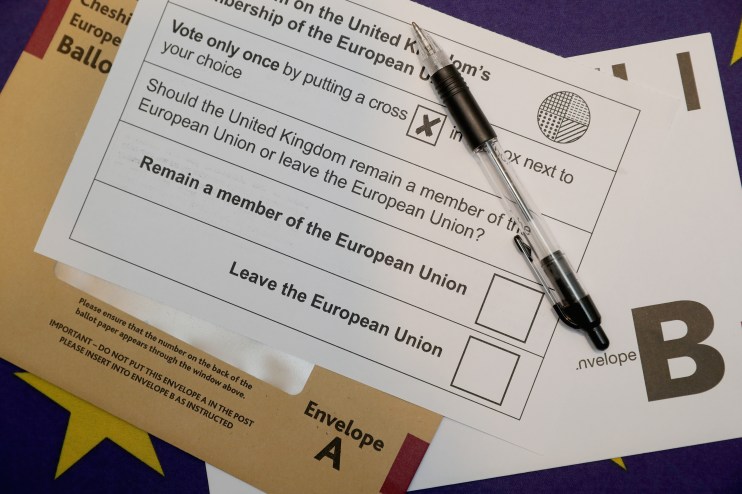
The Brexit referendum was 10 years ago today. A decade on, very little has been resolved, says Eliot Wilson
There have only ever been three UK-wide referendums. Appealing directly to the electorate on a single issue through a plebiscite fits awkwardly with parliamentary government, as Enoch Powell told the House of Commons in 1972: “The essence of our own responsible parliamentary democracy is that the Government are held totally responsible to the House of Commons, and the House is held totally responsible to the electorate.”
Referendums pass the buck. When Labour returned to power in 1974, it was split on the issue of the Common Market, and Harold Wilson had promised a referendum on the future of Britain’s membership to paper over his party’s cracks. In June 1975, the electorate voted 67-33 to stay in; there would not be another national referendum for more than 30 years.
The 2011 referendum on the Alternative Vote system was a concession by David Cameron to his Liberal Democrat coalition colleagues, but it was an unloved child. Turnout was only 42 per cent and two-thirds of those opted against the new voting system.
Ten years ago today, however, on Thursday 23 April 2016, came a simple Yes/No vote on whether the UK should remain in the European Union. David Cameron had seen, first as a special adviser to Chancellor Norman Lamont in 1992-93, how the Conservative Party had spent nearly 20 years in internecine warfare over Europe and wanted to end it.
David Cameron’s gamble
In 2012, with his Chief of Staff, Ed Llewellyn, and Foreign Secretary William Hague, Cameron raised the possibility of a referendum on EU membership as a concession to his party’s Eurosceptic wing, and to spike the guns of Nigel Farage’s increasingly successful UK Independence Party. In 2013, he announced that a referendum on renegotiated terms of membership would be in the Conservative manifesto at the next general election.
Exceeding expectations, the Conservatives gained 24 seats and won the election outright. In February 2016 Cameron declared that the referendum would be held on 23 June: Her Majesty’s Government would formally advise the electorate to vote to remain in the EU, but, as in 1975, collective responsibility on the issue would be waived and ministers could campaign to remain or leave.
For some Remainers, the very fact of the Brexit referendum is the original sin, the moment when the troubling of their lives began. But that view is formed in the light of the result; most would have been relaxed if Britain had voted to stay in the EU and the Eurosceptic fox had been shot.
I take the view that, whatever the outcome, a crisis, a definitive judgement on EU membership was inevitable. It was more than 40 years since the confirmatory referendum of 1975, and the nine-member Common Market was a pale shadow of the 28-strong, highly bureaucratic and centripetal European Union of 2016.
Fizzing fuse of public opinion
In the 2014 elections, UKIP had won 24 of the UK’s 87 seats in the European Parliament. This reflected a growing disenchantment with the EU, but also a rising tide of frustration that the organisation had transformed itself, yet for the opinion of the UK electorate had never been directly and specifically tested in 40 years. It added to an already-noxious sense of exclusion from public discourse, of voices ignored for saying the unfashionable thing. To assume that situation was sustainable was to ignore a fizzing fuse.
The result was narrow but seismic: 51.9 per cent voted to leave the EU and 48.1 per cent to remain. It seemed shocking then: the government and all the mainland British political parties supported Remain, except UKIP and the neutral Conservatives; so did the majority of big business, The Guardian, The Financial Times and The Daily Mirror, most trades unions, NATO and the World Bank.
Many saw what they wanted to see. But the opinion polls had pointed to a close and volatile contest. Although Remain had dominated 2015, by the following year the two sides were trading places regularly, Remain’s lead fluctuating between one and 19 per cent. Leave lagged slightly, but more than once outscored its opponents by 10 per cent. Matthew Elliott of Vote Leave was a formidable organiser and strategist, and Boris Johnson and Nigel Farage were the most eye-catching campaigners in politics. This energy contrasted with a fatal and seemingly presumptuous calm among some Remainers who took victory for granted.
What can we say about the Brexit vote ten years on? There are two separate elements. On Britain’s relationship with the EU, it is simply too early to tell: the UK did not formally leave until 31 January 2020. The losing side will point to estimates of economic loss attributable to Brexit – the only hypothetical question some politicians will ever address – but the situation is dynamic, not fixed. Too little coordinated effort has been made systematically to reimagine the UK outside the EU, but even the real 10-year mark in 2030 will only provide initial indications on such a profound change.
The issue of the UK’s membership of a supranational political and economic alliance – which is what the EU is – became a proxy for many other arguments. Clashes between globalism and protectionism, between social conservatives and liberals, town and country, London and the rest, graduates and non-graduates, all found a voice within the Brexit process
Brexit has had a more profound effect. The English Civil Wars set father against son, brother against brother; more prosaically, so too did Brexit. The issue of the UK’s membership of a supranational political and economic alliance – which is what the EU is – became a proxy for many other arguments. Clashes between globalism and protectionism, between social conservatives and liberals, town and country, London and the rest, graduates and non-graduates, all found a voice within the Brexit process.
We have losst the ability to listen to each other
We have become a more polarised electorate, quicker to anger and slower to listen. Brexit became a language of grievances: of those who felt excluded and passed by; and those for whom an attachment to Europe and its culture was a building block of their identity. The presenters of the podcast The Rest Is Politics, Rory Stewart and (ironically) Alastair Campbell, talk of the imperative to “disagree agreeably”, but Brexit’s fault lines have led to an atmosphere of bone-deep antagonism. Simply, we have lost the ability to tolerate each other.
That intense, antagonistic temper has put the traditional British party system under extreme pressure from which it may not recover. Political parties are a way of corralling those with broadly similar beliefs and identities, but from the first steps towards European collaboration in the early 1950s, opinions on Britain’s involvement cut messily across party boundaries.
Opposition to the EU allowed first UKIP then the Brexit Party and now Reform UK to amass votes on a single issue but permitted supporters to read their own instincts into the movement. The inevitable tension on other issues remain unresolved: is it free-market or protectionist, libertarian or authoritarian, collectivist or entrepreneurial? It has yet to be forced to decide.
This has been the wider legacy of Brexit, a work in progress. It took one issue, membership of the EU, on which almost all parties had at least some internal divisions, and made it for a time the supreme shibboleth, the determinant of inclusion or exclusion like the Test Acts of Restoration England. It has forced us to look at political parties and identities in a new, unfamiliar and uncomfortable way.
The political system may emerge battered but essentially unchanged, the traditional indicators of Left and Right re-emerging. But they may not, and it is impossible to say what might appear in their places.
Eliot Wilson is an author and historian