‘Moron premium’ – Westminster turmoil has ‘cost taxpayers £35bn’ since 2022

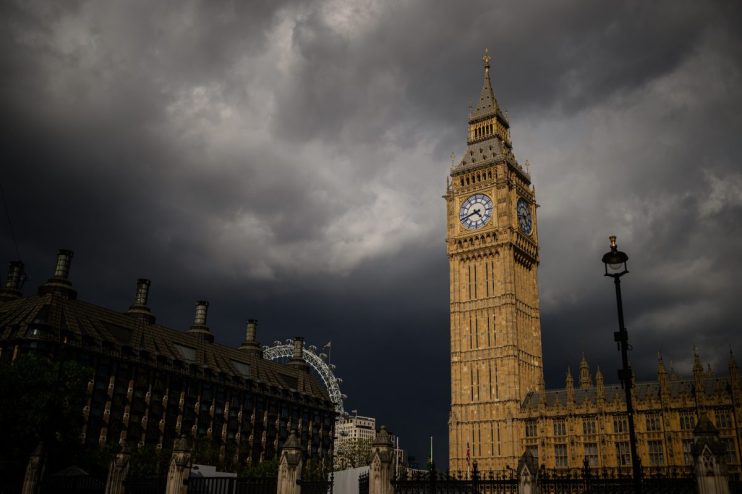
Secretive plotters and vengeful strategists in Westminster have cost taxpayers around £35bn since 2020, new research by one of the world’s top insurance companies has found.
In a study into the costs of political fragility facing European governments, researchers at Allianz Trade found that the UK government continued to pay a “distinct political premium” due to constant uncertainty over tax and spending decisions.
Isolating the additional interest rate the UK pays on government borrowing, a report estimated that turbulence in Westminster cost taxpayers nearly £35bn more to cover debt payments. This higher premium relates to costs that have already been paid off by the government or still to be serviced as bonds mature.
The UK has had five Prime Ministers since the start of 2022 – Boris Johnson, Liz Truss, Rishi Sunak, Sir Keir Starmer and now Andy Burnham. Italy has had just two in Mario Draghi and Giorgia Meloni despite a reputation for rapidly changing leaders.
The cost of UK politics
Several major political events over the last four years have swung UK government bond traders into action, including the Liz Truss mini-Budget episode in late 2022, Rachel Reeves’ decision to loosen fiscal rules and ditch planned income tax rises, and Andy Burnham’s criticism of the government being “in hock to the bond markets” while serving as mayor in Greater Manchester.
The report pointed out that the Truss mini-budget, which proposed a series of unfunded tax cuts and spending commitments on energy, led to long-term gilt yields rising by as much as 120 basis points.
Following the Truss mini-budget, investors ridiculed the UK for having a “moron premium”. The UK government is set to pay its lenders around £110bn in debt interest costs this year, nearly double the size of the defence budget and near to the level paid on education each year.
Ten-year gilt yields, the benchmark for UK government borrowing costs, hit a low of around 3.5 per cent in early 2024 yet are now hovering around five per cent.
Commentators have ascribed the UK’s political ills to different factors, ranging from slow economic growth rates to an appetite within parties for ousting unpopular leaders.
Burnham’s economics adviser and former Goldman Sachs executive Jim O’Neill has said leaders need to stop being “obsessed with the daily signals emanating from social media, opinion polls, and the Westminster bubble”. Other City banks have also cautioned against recent political churn and constant leadership changes.
UK’s warning for Italy
Investment officer and chief economist Ludovic Subran, investment strategist Patrick Krizan and the research assistant Pierpaolo Fiore said bond markets had “never been more sensitive” to political changes across Europe.
Researchers raised the alarm on the impact that elections in France, Spain and Italy next year could have for continent-wide debt servicing costs.
Allianz’s new “political fragility index” measures the extent to which leadership battles, polarisation and voting patterns can swing bond prices.
Over the last six years, the UK has been measured as having one of the lowest index scores to one of the highest, behind just the Netherlands, Belgium and France. As of July 2026, the UK scored third lowest out of eight countries tracked by Allianz.
But the report suggested that the UK continues to suffer from a larger gilt premia than the likes of Netherlands due to its reliance on political majorities that “concentrates power and is decisive but not resolute, so one election can especially rewrite the budget”.
Out of the European countries tracked by Allianz, it estimated that political fragility has added between two and five per cent to annual debt servicing costs. Since the end of quantitative easing in 2022 by central banks, estimates suggest that the cumulative cost to the countries altogether has been 98bn euros, which amounts to roughly £83.8bn.
The largest burden of costs has come in the UK where costs for the government over four years have added up to 41bn euros, or about £35bn.
Economists at the insurer said they expected bigger risks on Italy’s risk premia due to far-right forces that could lead to more Eurosceptic politics, putting pressure on the bloc’s currency.