Corgi Cafe: My day at London’s 24/7 hub for tech bros

San Francisco startup Corgi is offering hustling Londoners a place to grind 24/7. Anna Moloney dares to go inside
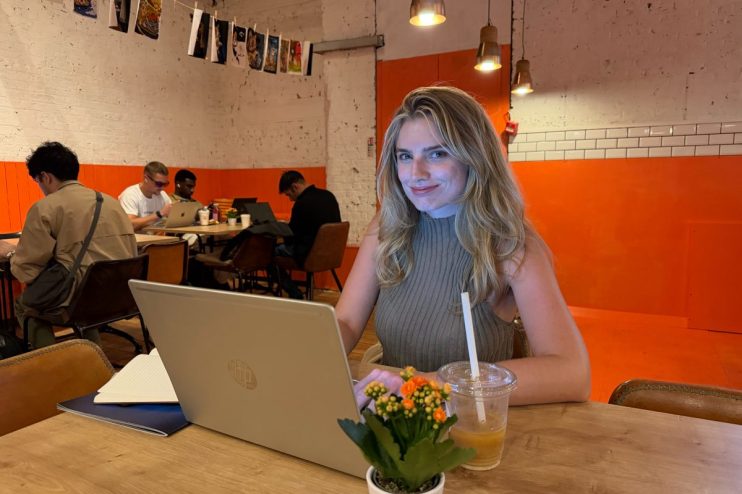
When I originally read about a “24/7 cafe for builders”, I assumed this meant a place for construction workers to get a cuppa. That was the first sign I didn’t belong at Corgi Cafe. The second came as I looked up bewildered at a fresco above my head depicting a take on Michelangelo’s The Creation of Adam, in which God, Adam and the angels were all depicted as corgis. Corgi community manager Claudia Maggi, who met me at the cafe, noted that I looked intrigued by it all, as I cast my eyes curiously around the site, where roughly 20 young men sat hunched over laptops at shared tables in a cafe I can only describe as having a Grok-coded aesthetic. It’s not for everyone, she added, by way of reassurance.
Indeed it is not. Opened just last week in Shoreditch, Corgi Cafe is a space explicitly targeted at the “very ambitious”, those who “want to work hard, but [don’t] know where to go”. Builder, in this context, means those building their own companies, the highest form of creation in Old Street. Open 24 hours a day, seven days a week, the cafe bills itself as part hangout, part co-working spot with patrons, unlike many London cafes, encouraged to bring their laptops and settle in. While I was there, countless workers appeared not to have purchased anything, or at least not for a long time, and I myself nursed a flat white for three hours with no apparent issue.
The cafe itself was not in the best of shape. The overall look was more shabby than chic, with there being only so much neon orange paint can do for an exposed brick wall. Likewise, the wifi, arguably crucial, was not working (a staff member said it was being replaced) and when I asked for a tea at 11:30pm I was told they were not yet allowed to serve hot drinks overnight; the only thing they could offer me at midnight was an iced matcha latte.
To my dismay also, the aforementioned corgi tribute was just one of many, with an artist hard at work at a full-wall adapted mural of Raphael’s School of Athens (but, you guessed it, everyone’s a corgi) as an additional statement piece for the cafe. Above my head, additionally, hung dozens more corgis in the classical art style, these ones instead created by engineers during a community event held over the weekend.
An insurance unicorn with a cafe: what even is Corgi?
While this is Corgi’s first London location, the brand is already well established in San Francisco, where its parent company, an AI insurance start-up launched in 2024 by co-founders Nico Laqua and Emily Yuan, is headed up. Despite being barely two years old, the company is already valued at around $4bn and is famous for its intense work culture. Laqua himself works seven days a week and sleeps for only three hours a night on a mattress he keeps on the floor of his office. When asked on the 20VC podcast if he’d rather Corgi was a trillion-dollar company but he died at 50, or it was a failure and he lived til 80, he said the answer was easily the former, and that he would rather measure his lifespan “in victories than years”.
Such an intensive work culture is also encouraged for Corgi’s workforce, who work seven days a week. Two thirds of the company’s first 30 members of staff have tattoos of the Corgi logo and anyone who wants to take Saturday and Sunday off simply does “not have a place at Corgi”, says Laqua, though he has conceded employees can take a rest day “every now and then” if they need it.
His co-founder Yuan shares the same spirit. When asked by the Wall Street Journal about the social sacrifices, she simply said: “Why would I go drink at a bar if I can be building a company?” If, by the way, you can think of a few answers to that question, don’t go to Corgi.
Within this context, the cafe’s function as an extension of the Corgi worldview becomes easier to understand. The first Corgi Cafe in San Francisco only opened in February, but already it seems to have a hold on the cultural imagination of the tech scene. For the London opening, Moggi told me she had had to do no real marketing, just post on socials, where the community was ready and waiting.
‘How are we supposed to grind?’
Indeed, when I arrived at Corgi at a slovenly 11am on a Tuesday, just a little over a week after its launch, it was packed. Bar a couple of strays who came in thinking it was a dog cafe (and then leaving severely disappointed), by my own observations the clientele were around 90 per cent male and 50 per cent baseball-capped; in other words, the target customer.
Old Street, or Silicon Roundabout, as the choice of location is obviously also well thought through, but so too was the choice to land in London more generally. Interestingly, the company chose London before New York both for an office and a cafe. Laqua has described himself as “very bullish” and “very long” on London, and said he sees as having a unique opportunity to become an AI centre as US visas become harder to obtain, though he does view the number of pubs “as a problem”. That aside, it’s certainly another vote of confidence for ‘Londonmaxxing’, a word coined by the tech community earlier this year to describe renewed positivity around the city’s start-up scene.
And if my visit to Corgi was anything to go by, there’s certainly a lot of young men feeling positive about London’s startup scene. After my morning shift, I decided to drop back into Corgi overnight to see whether the 24/7 offering was actually capturing people. To my surprise, it was as busy at midnight as it had been at midday, with around 17 customers, one, for unknown reasons, wearing red sunglasses in the fluorescently lit room, plugging away at their laptops. One group, when finding there were not enough seats, left despairing loudly, “How are we supposed to grind?”
Most, it appeared, had found the cafe via social media. When asked how he’d come across the cafe, the boy at the table next to me, a maths student revising for his exams, told me he’d seen a Tiktok saying the founder had set up the cafe because Londoners weren’t working hard enough. “That’s probably true,” he said.
Notable during my visit was a distinct sense of pride at being part of this new tech space. Many people when leaving would stop outside to take a picture of the striking orange shopfront, presumably to post on socials or share with their friends. One group of boys who came in armed with laptops proudly declared they’d “make a Corgi corner” at the back. In the queue, I watched as strangers struck up conversation: “Are we tech bros? How can you tell!” a girl in a branded cap laughed. By the end of the conversation she’d invited the others to her start-up’s ice cream popup. “Wow we really got the Corgi experience!,” one remarked on the way out. In this sphere you see, Corgi is not merely a company but a worldview.