Andy Burnham: being all things to all men will end up letting everyone down

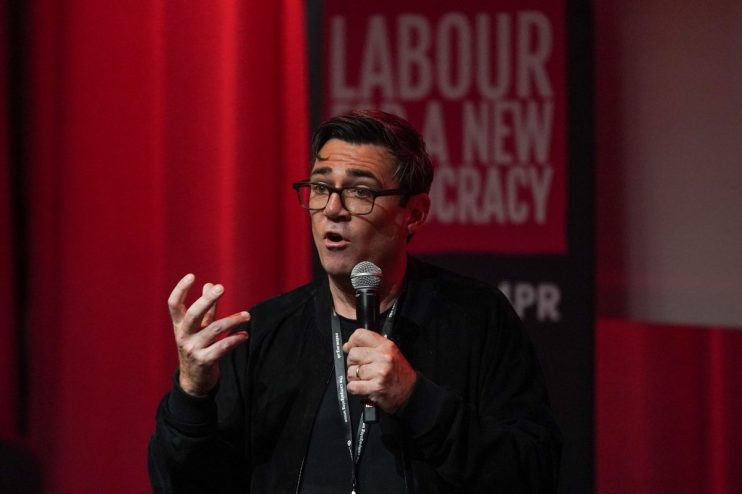
Andy Burnham has made a series of promises he knows he can’t keep. Either that he does not care, so consumed is he with ambition to be Prime Minister, or that he believes he will somehow find a way to make the circle appear squared and satisfy a broad spectrum of opinion. Indifference or mendacity – what a choice, says Eliot Wilson
Following Andy Burnham’s victory in last week’s Makerfield by-election, the Labour Party finds itself in a peculiar position. Burnham and Sir Keir Starmer are not formally or publicly enemies, yet Burnham long ago stopped making a secret of the fact that he wants Starmer’s job and is actively seeking to supplant him as Prime Minister.
In this world nothing can be said to be certain, except death and taxes, of course, and I predicted at the beginning of the year that Starmer would see out 2026 in Downing Street, but there is a good chance Burnham will oust him. Certainly, the Mayor of Greater Manchester – as Burnham remains until a by-election, probably in July – has been campaigning in earnest, sketching the kind of administration his colleagues and the electorate could expect him to lead.
Much of Burnham’s appeal is simply that he is not Starmer. There is panic in Labour ranks, with one survey suggesting the party could be reduced to 83 seats in the House of Commons at the next election; that would be an existential challenge, its worst performance since 1931 and second worst since it elbowed the divided Liberals aside to become the Official Opposition in 1922. Labour MPs will examine almost any alternative to their current living nightmare.
Insofar as Burnham’s offer goes further than repeating the word “Manchesterism” with a knowing look and owning a sizeable wardrobe of casual jackets, the new MP for Makerfield has been extremely generous in his promises. According to a recent analysis by Labour List, he would reduce income tax for the lowest paid workers, review the rise in employers’ National Insurance Contributions and in inheritance tax for farmers, cut business rates for pubs and small businesses, increase defence spending through additional borrowing, restore the £2 cap on bus fares and find some way of compensating the 3.5m WASPI women (before walking that last pledge back).
Burnham has also committed to retaining the triple lock on pensions, exempting pensioners from VAT and resurrecting the northern leg of High Speed 2 from Birmingham to Manchester. Yet he has indicated a reluctance to raise the level of taxation; has talked vaguely or remaining within the parameters of the current Chancellor of the Exchequer’s much-vaunted “fiscal rules”; and on the burgeoning cost of health and disability benefits – expected to exceed £100bn by 2030 – the furthest he is willing to go is to say, nebulously, that his is “not squeamish about saying that the plan would be to reduce the welfare bill”.
Reckless fiscal incontinence
If this seems like a reckless bout of fiscal incontinence, it is because that is precisely what it is. Burnham has thrown spending commitments around as if Theresa May’s “magic money tree” was a newly discovered botanical phenomenon, and some of them have proved less enduring than milk left on a warm radiator.
I’m old enough to remember Burnham in his first Westminster incarnation: as a junior minister skipping from one unpromising brief to another – ID cards at the Home Office, NHS reform and delivery at the Department of Health – then in Gordon Brown’s Cabinet, where his empathetic, kohl-rimmed eyes were more noticeable than policy triumphs. Some Labour MPs have invested more desperate hope in “the King of North” than he can possibly justify. But he is not a stupid man, Cambridge-educated and with nearly 30 years’ experience of politics in one form or another including 11 years on Labour’s front bench.
So he knows he is promising an undeliverable all-gain, no-pain pick and mix of policies to attract support from as wide a spectrum as possible. Without making a window into his soul, he must know that his carefully calculated individual measures, when taken as a whole, are no more anchored in the crushing compromises and greyscale of real-world government than a Nadine Dorries memoir.
That is why the stall he is setting out is unforgivably cavalier and irresponsible. We talk about hot-button issues like immigration, the cost of living, social care and law and order, but underlying everything is a collapse in trust: Around half of voters almost never trust governments of any party to act in the national interest or tell the truth, a figure that has risen by 20 per cent since 2020. As an electorate, we have internationally low levels of trust in our political institutions.
One of the biggest drivers of this collapse has been repeated failures of delivery. Politicians have promised the moon and delivered a low-watt bulb. The ongoing battle over the delayed and inadequate Defence Investment Plan is proof of that. And as his fingertips reach for the Labour crown, Burnham must know, unless he has downed gallons of his own Flavor Aid, that he is perpetuating this pattern. He is setting out a range of commitments which cannot possibly be honoured in full.
We are forced to the conclusion either that he does not care, so consumed is he with ambition to be Prime Minister, or that he believes he will somehow find a way to make the circle appear squared and satisfy a broad spectrum of opinion. Indifference or mendacity – what a choice.
In fact he is set to continue the undermining of public trust that leaders and ministers of both parties have wrought over the last decade or two. I have always believed that trend is reversible over time, that trust can be rebuilt, and that we have to be realistic enough to accept there never was a golden age when British politicians were admired and revered as moral paragons. But arresting the decline will require an embrace of frankness and realism in how politicians talk to voters. Andy Burnham’s high-spending big tent does not just fail to do that: it has the potential to corrode public trust even further.
“Get a grip on the everyday basics,” he advised the Prime Minister last year. If only he could remember his own words of wisdom.
Eliot Wilson is a writer and historian