A love letter to Sweetings, the City’s oldest restaurant

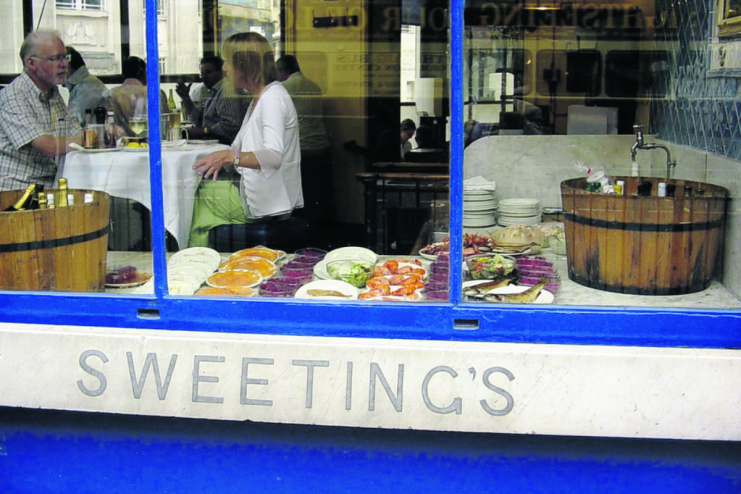
Ahead of our Toast the City Awards this October, we pay homage to Sweetings, the City’s oldest restaurant
Britain is a country steeped in tradition and often too wedded to the past, but it also proved itself capable of great innovation. We should never forget that the Square Mile is a perfect example of world-changing innovation. In 1571, Sir Thomas Gresham’s Royal Exchange gave London merchants a home from which to ply their commerce; the establishment of the Bank of England in 1694 transformed the Crown’s access to borrowing and allowed it to make the Royal Navy globally dominant.
At the same time, Lloyd’s Coffee House was giving birth to the eponymous insurers and shipping register, and the brokers who thronged Jonathon’s Coffee-House created what would become the London Stock Exchange, one of the world’s oldest.
But Britain has another genius too, a cocktail of those I’ve just identified: as a nation, we are past masters at fighting rearguard actions, sometimes against inevitable change. Again, look at the City: by the early 1980s, the Stock Exchange was a clubby, cliquey institution still dominated by “chaps” from good families and good schools. It was only in 1973 that women and foreign-born traders had been allowed on the trading floor. The deregulation of 1986—”Big Bang”—changed all that, and London is still one of the world’s great financial centres.
Another Square Mile legend to be reborn
Dotted in and around the City you can still find some relics of bygone ages, living time capsules of another London. The most obvious are the restaurants which served—and still cater for—patrons who have the vestigial habits and taste of respectable Edwardian men of business and property. Several have endured and flourished just beyond the formal limits of the City, like Rules, Scott’s, Bentley’s and J. Sheekey.
Within the Square Mile life has been harder: Simpson’s Tavern closed suddenly during the Covid-19 pandemic but has been reborn as Cloth Cornhill; the Quality Chop House endures, and life goes on at Sweetings, in the Albert Buildings on Queen Victoria Street, much as it has done since moving into the premises in 1889.
Sweetings: the Victorian features remain
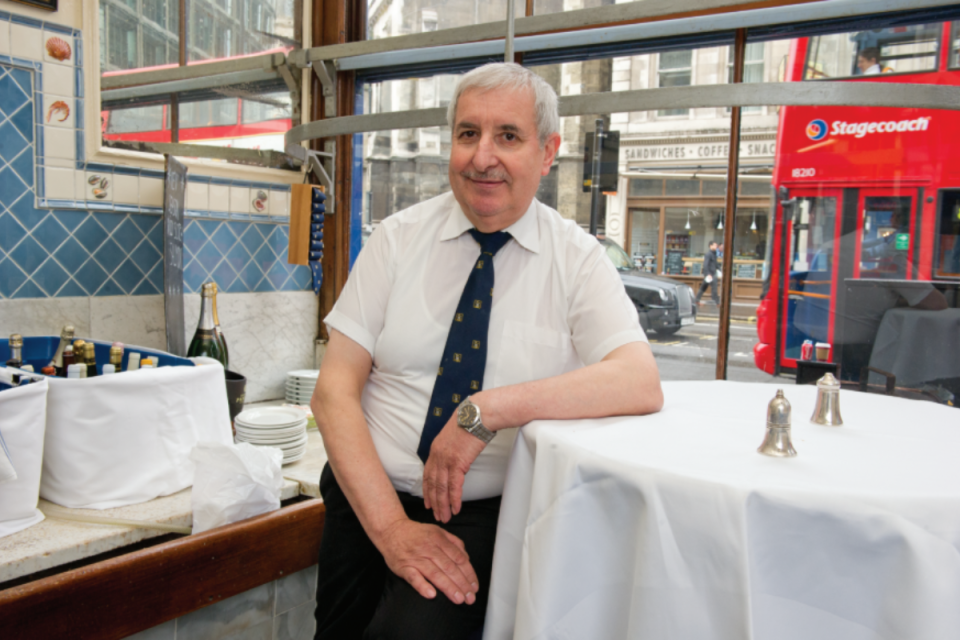
It is an overused phrase but Sweetings really is a City institution. What had begun as John S. Sweetings, Fish and Oyster Merchant was nearly 60 years old when it took up residence in the Albert Buildings, a grand, wedge-shaped construction built speculatively for offices in 1871. It began as a wholesaler on Lad Lane in Islington in 1830, with a restaurant at 159 Cheapside, then 17 Milk Street, where it billed itself as “Very Superior Oyster Rooms”.
The contemporary Sweetings does not offer what most diners would regard as a wide menu. There is fish—Dover sole, halibut, turbot, skate, plaice—lobster and crab and, for some the main event, oysters. A few anodyne vegetable side dishes, a handful of “puddings” and, joy upon joy for the unreconstructed like me, a selection of savouries. An attentive waiter could learn the menu in an hour. If fish is not your scene, you have assuredly come to the wrong restaurant.
The original interior remains: acres of dark wood, an imposing bar with stools at which diners can perch if they choose, and tables for the more conventional and milquetoast clientele. For the experience alone, it’s worth ordering Black Velvet to drink: although the 50/50 mixture of Guinness and champagne was first served in Brooks’s Club in St James’s in 1861 to mark the sudden death of Prince Albert, Sweetings has leaned heavily into its Victorian associations, serving it in silver tankards for that elusive and very British combination of prosperous high living and boorishness.
The Square Mile how it once was
When you discover that Sweetings does not accept reservations and opens solely (forgive the pun) for weekday lunches, you might begin to wonder what kind of a restaurant this is, with so many conditions and limitations placed on the patrons. The truth is that it is not really a restaurant at all, not in the sense that the modern world understands.
When the doors opened on Sweetings’s current site, London was the biggest city in the world and the capital of the biggest empire the world had seen. With five million people it was twice the size of Paris, three times that of New York and Berlin, and growing at a staggering rate. It was a city where everyone knew their place; it was not necessary to like it (the previous year had seen at least four women brutally murdered by a serial killer in the savagely poor district of Whitechapel). The ruling order was acutely conscious of threats from anarchism, the beginnings of organised labour, Fenianism and all kinds of radical political violence.
For the lords of finance in the Square Mile, life shaped itself around them and occasionally still does so, which is why it can feel like an awkward fit in 2026. Most clubs were to the west around St James’s, so for a hearty lunch—and the Victorians knew no other kind—establishments like Sweetings offered what hungry plutocrats needed. There would be well-cooked fish, fresh oysters, puddings and enough alcohol to wash everything down, served with decorous efficiency in comfortable surroundings. What the panjandrums of high finance did not need was the agony of choice or the flummery of a formal dinner, nor was it necessary to cater for women.
Late Victorian London
Familiarity would rule. Victorian and Edwardian gentlemen would recognise the thrum of the efficient feeding of large numbers form the dining halls of public schools and universities, and some from the officers’ messes of the British Army at home or in India.
These were not wholly public spaces but communal ones. Certainly they were not private, but those towards the top of the social order neither needed nor expected privacy. Sweetings would be part of the daily routine, and for the masters of the universe of late Victoria London, it blended seamlessly into everyday life.
But that British ability to fight rearguard actions comes into play. What was everyday to our forebears now seems to us extraordinary, and that is a gift we have granted ourselves. The Victorian City of London may have vanished under unimaginable levels of change, but in a few places the past still whispers to us. This is how it once was, it murmurs, and it was glorious.
Go to sweetingsrestaurant.com