The Bayeux Tapestry is British – we should keep it

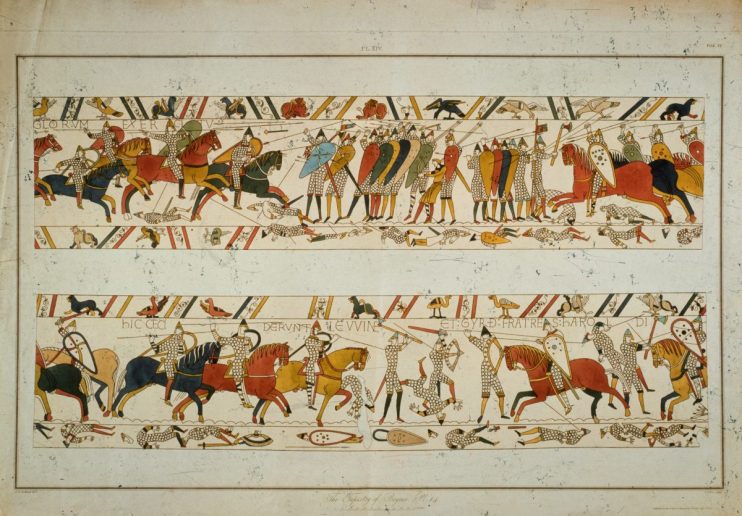
Despite its name, the Bayeux Tapestry is British…and it should therefore be kept permanently in the British Museum, argues James Ford
I have a big problem with the Bayeux Tapestry. Firstly, it is not a tapestry, it is an embroidery. Secondly, it was not made in Bayeux. Historians believe it was stitched and sewn in Kent, probably around Canterbury. So, by rights, it should really be called the Canterbury Embroidery.
There is perhaps a poetic irony to the fact that the British Museum’s feted guest exhibit is probably more English than 90 per cent of the stuff in the Museum’s collection. But my issue is not with the name of the Bayeux Tapestry so much as what this naming convention represents: victor’s history. The, ahem, Canterbury Embroidery is war loot. Booty. The ill-gotten gains of French colonialism.
There is no ignoring the fact that the Canterbury Embroidery is English. Therefore, rather than merely visiting the British Museum this year and next, it should rightly be a permanent part of the Museum’s collection. There is clearly great interest in this artifact in the UK: tickets for the first four months of the exhibition at the British Museum sold out within 24 hours.
If you believe, as many do, that the Elgin Marbles should be returned to Greece or the Benin Bronzes belong in Nigeria then you should believe that the Bayeux Tapestry – sorry, the Canterbury Embroidery – belongs in Britain permanently. The usual suspects – lefty activists, woke politicians, right-on historians and self-important luvvies – should be irate about the blatant outrage of the Canterbury Embroidery’s co-opted Frenchness. They should be protesting outside the British Museum in droves. They should be waging a high-profile campaign for the return of the Canterbury Embroidery. We should all be manning the barricades outside the French Embassy demanding the rightful return of one of England’s greatest treasures. At the very least, many more angry opinion columns about the Englishness of its origins should be being scribbled than just this one.
But, instead, you won’t hear a peep about this. In fact, it is an act of rank hypocrisy that those who advocate for the return of other relics of British colonialism are silent when it comes to a relic of Norman colonialism like the Canterbury Embroidery. There is a very tangible double standard here.
A symbol of our own oppression
We are supposed to all want to ‘decolonise our history’ as part of some exercise in national self-flagellation. It is one of the many contested fronts of the UK’s culture wars. But there is probably no better example of colonised history than the French having this jewel of British craftsmanship. The Normans were colonisers (and pretty vicious ones at that). They didn’t need all those castles because the Anglo-Saxons were pleased to see them. The Battle of Hastings was not a minor scuffle on the south coast. And the Harrying of the North was not a mild exchange of intemperate language. It was part of the violent oppression and subjugation of England. Yet we selectively choose to ignore the more uncomfortable truths about 1066.
Are we supposed to be happy about paying a staggering £33 per head to queue up for the privilege of meekly staring at the best-known symbol of our own oppression? Maybe we should buy a tea towel in the gift shop on our way out to properly commemorate the indignity. Should we be grateful that the French have lent us something that, over 70 metres, rubs our face in one of the greatest defeats in our history? If we keep the Canterbury Embroidery maybe, in return, we could let the French have a 70-metre-long embroidery depicting the battles of Agincourt or Waterloo or Trafalgar to hang in the Bayeux Museum instead.
When the Canterbury Embroidery’s time at the British Museum is up, let’s just keep it. It belongs in England. It should be generating revenue for the British Museum, not the Bayeux Museum. By rights the French owe us reparations for all the years that it has been held hostage in France, lining the pockets of the French state. If we refuse to give it back, what are the French going to do about it? Write a strongly worded letter of protest? Re-invade? What are the chances of them getting lucky in battle at Hastings twice in a millenium? At the very least, let’s stop calling it the Bayeux Tapestry. Like Harold at Hastings, this is one hill I’m willing to die on.